First Suffolk Senate: Nick Collins faces a Wu-backed primary challenge
Boston Mayor Michelle Wu’s endorsement of Latoya Gayle sets up a high-profile primary challenge to incumbent Senator Nick Collins in a First Suffolk district that redistricting has quietly remade.
On September 1, Democratic primary voters in the First Suffolk district will decide whether to send state Senator Nick Collins back to Beacon Hill for another term or to nominate one of two Democratic challengers. The higher-profile challenger is Latoya Gayle, a first-time candidate backed by Boston Mayor Michelle Wu, making this a proxy war between Wu and one of her most persistent legislative antagonists.
Collins, a South Boston Democrat who has held the seat since a 2018 special election, is a conservative voice representing a portion of the much more progressive City of Boston. Gayle, 47, a Dorchester resident and advocacy director at the early-education nonprofit Neighborhood Villages, entered as a political newcomer and picked up Wu’s endorsement on June 3. A third Democrat, Juwan Skeens—who lost to Collins in 2024—is also on the ballot, raising some concerns about progressive vote splitting.
Mayor Wu and Senator Collins have clashed publicly, chiefly over her push to shift more of Boston’s property-tax burden onto commercial real estate, a measure Collins repeatedly helped block in the Senate. Her backing came with two labor unions (SEIU and AFSCME Local 703) and political experience—Gayle’s campaign manager previously worked in Wu’s City Hall.
| Candidate | Background | Raised in 2026 | Cash on hand |
|---|---|---|---|
| Nick Collins | Incumbent since 2018. South Boston; former state representative and a conservative Democrat in a progressive-led Senate. | $246,712 | $100,568 |
| Latoya Gayle | First-time candidate from Dorchester; advocacy director at the nonprofit Neighborhood Villages. Endorsed by Mayor Wu, SEIU, and AFSCME Local 703. | $49,560 | $18,760 |
| Juwan Skeens | Former staffer to Attorney General Andrea Campbell; challenged Collins in 2024, losing by better than three to one. | $48 | $35 |
| Year-to-date receipts and ending cash on hand as of June 30, 2026 (Massachusetts Office of Campaign and Political Finance). | |||
The fundamentals favor the incumbent. Collins has out-raised Gayle by roughly five to one this year and held about $100,000 in cash at the end of June to Gayle’s $19,000. An internal poll his campaign circulated in June showed him ahead 82 percent to Gayle’s 10 and Skeens’s 9—a figure to treat with the skepticism any internal poll deserves, but a plausible signal of the name recognition an eight-year incumbent carries into a low-turnout September primary.
But the First Suffolk district has changed a great deal from the one Collins first won in 2018. The four maps below portray the district’s demographics as they stand today, and the trend lines that follow show how sharply—and how recently—those demographics have changed.
White Working-Class
White working-class share of each First Suffolk precinct
Race and Ethnicity
Largest racial or ethnic group for each precinct
Income
Median household income by precinct (top-coded at $250K)
Diversity and Affluence
Diversity-Affluence Index—income percentile times racial diversity. High values flag precincts that are both racially mixed and high-income, surfacing the gentrifying neighborhoods that the race and income maps each tell only half of.
How the District Has Changed
The maps above are a snapshot. But the First Suffolk district that Nick Collins represents today is not the one his predecessors held—and not because the neighborhoods themselves were transformed. The chart below tracks the district’s race and ethnicity using American Community Survey (ACS) 5-year estimates from 2009 to 2024. The dashed lines mark the two redistricting cycles that fall within this window.
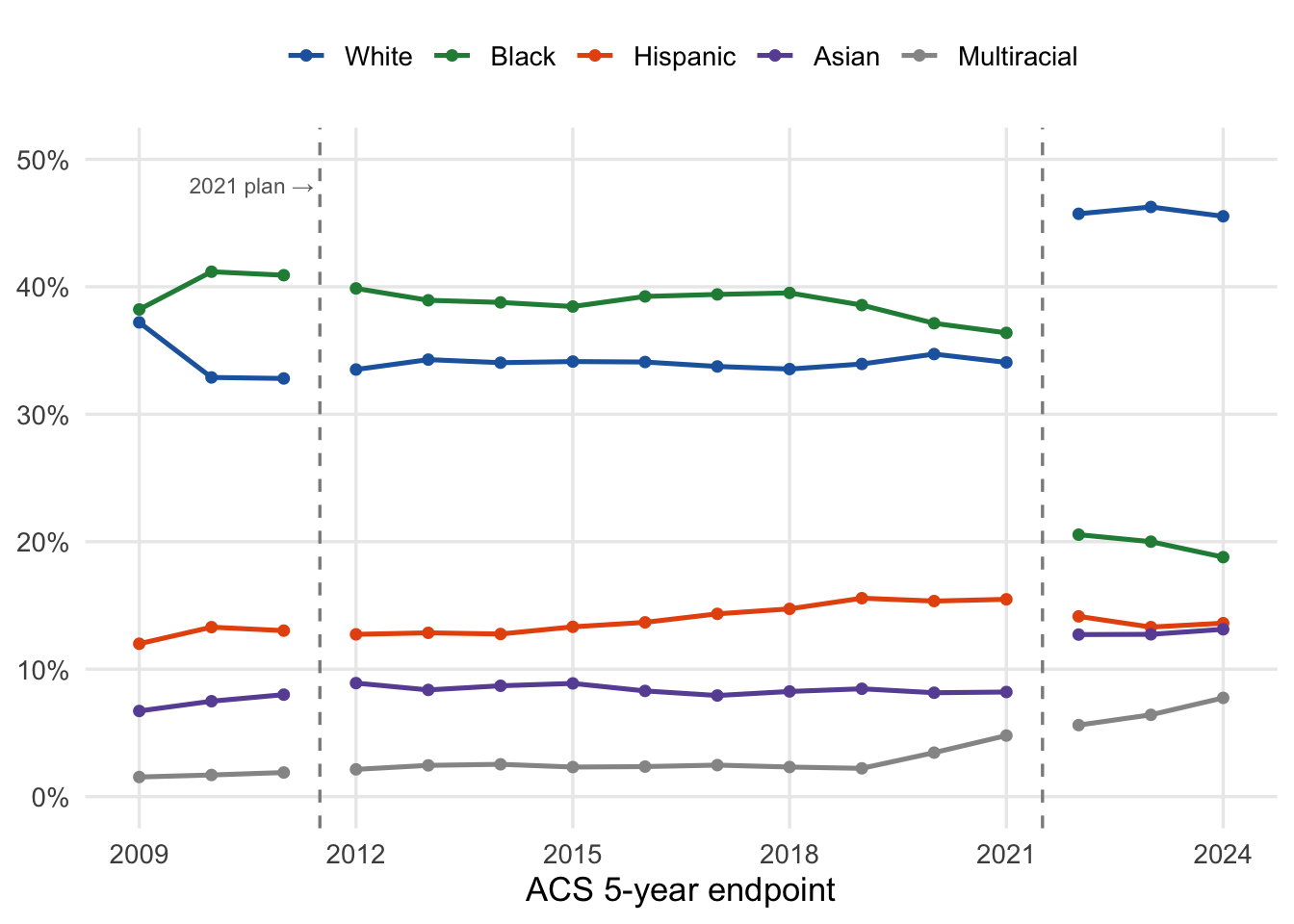
The trends between redistricting map changes are gradual. Under the 2011 map (2012–2021), the district drifted slowly, with the Black share easing from roughly 41% toward 36% as Hispanic and white-collar residents grew. Then the lines jump discontinuously at the 2021 redistricting—White rises from about 34% to 46%, Black falls from 36% to 21%, and Asian climbs from 8% to 13% in a single step. That break is a boundary effect, not a neighborhood shift: the new map traded Dorchester precincts for more of South Boston and the Seaport. The 2021 redistricting reshaped First Suffolk more than fifteen years of demographic change did.
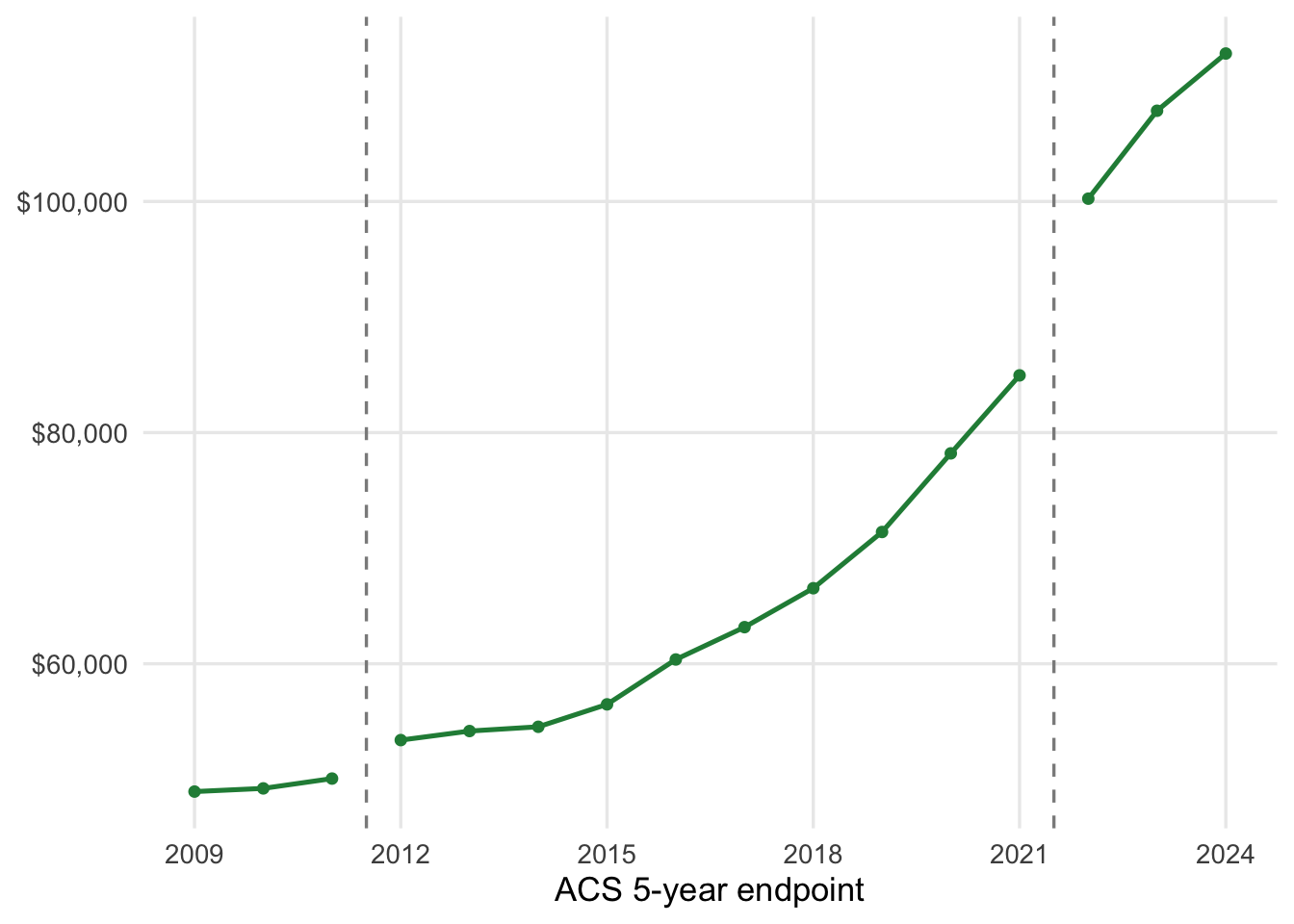
Median household income climbed steadily across both eras—from under $50,000 in the 2005–2009 window to nearly $113,000 in 2020–2024—but the 2021 redistricting created a large one-time bump, lifting the figure past $100,000 by folding in the district’s newly added wealthier waterfront precincts.
What September 1 Will Test
The demographic story cuts both ways for the challenger. On paper, the post-2021 map is friendlier to Collins than the one he first won: it is whiter, wealthier, and more firmly anchored in South Boston and the Seaport, where his name—and the annual St. Patrick’s Day Breakfast he hosts—still carries weight. An incumbent who has never had to sweat a general election in this seat starts with the terrain tilted his way.
Yet the same redistricting added some unfamiliar ground. Much of the South End—which is more progressive and has less history with Collins—is now in the district. But Gayle will likely need to run the table in the South End and Dorchester, especially the areas that are high on the Diversity-Affluence scale, while limiting damage in South Boston.
Skeens raises an additional challenge. A progressive who won a couple thousand votes against Collins in 2024, he may draw a similar number in 2026—and those are votes more likely to come at Gayle’s expense than Collins’s.
Gayle is not the favorite to win in September. The money and the sheer difficulty of unseating a Massachusetts incumbent both point the other way. But the district Collins is defending has been shifting beneath him—some of it slowly, but most of it in one redistricting jolt—and Wu’s endorsement is a bet that it has shifted far enough to matter. September 1 will measure whether it has.